Table of Contents
Artificial intelligence is no longer limited to large cloud data centers. In 2026, more businesses are running smaller AI models directly on devices, local servers, industrial equipment, vehicles, cameras, and IoT systems. This shift toward edge computing helps reduce latency, lower cloud costs, improve privacy, and keep applications running even when internet connectivity is limited.
If you want faster AI responses without constantly sending data to the cloud, choosing the right edge computing platform is essential. The best platforms make it easier to deploy, manage, update, and monitor AI workloads close to where data is generated.
In this guide, you will discover the best edge computing platforms for running smaller AI models in 2026. These solutions support everything from computer vision and predictive maintenance to smart retail, robotics, healthcare devices, and industrial automation.
Quick Summary Table 📊
| Platform | Best For | Key Strength |
|---|---|---|
| AWS IoT Greengrass | AWS users | Strong cloud-to-edge integration |
| Microsoft Azure IoT Edge | Enterprise environments | Excellent Microsoft ecosystem support |
| NVIDIA Jetson Platform | AI inference at the edge | Powerful GPU acceleration |
| Google Distributed Cloud Edge | Large-scale deployments | Advanced AI and analytics tools |
| Red Hat OpenShift Edge | Hybrid infrastructure | Kubernetes-based flexibility |
| Edge Impulse | TinyML projects | Easy model deployment to devices |
| KubeEdge | Open-source deployments | Cloud-native edge management |
| IBM Edge Application Manager | Enterprise automation | Large-scale device orchestration |
| ZEDEDA | Distributed edge infrastructure | Simplified edge operations |
| Canonical MicroCloud | Lightweight edge environments | Efficient resource management |
How We Ranked These Platforms 🔍
When evaluating edge computing platforms for smaller AI models, we focused on the factors that matter most in real-world deployments:
- AI model deployment simplicity
- Performance for edge inference workloads
- Scalability across multiple locations
- Security and device management features
- Hardware compatibility
- Developer experience and documentation
- Cloud integration capabilities
- Resource efficiency
- Monitoring and analytics tools
- Long-term ecosystem support
1. AWS IoT Greengrass ☁️
AWS IoT Greengrass remains one of the strongest edge computing platforms in 2026. It extends Amazon Web Services capabilities directly to local devices, allowing AI applications to run without relying on constant cloud connectivity.
One of its biggest advantages is seamless integration with AWS services. You can build machine learning models in the cloud and deploy them to edge devices with minimal effort. This approach simplifies management while maintaining consistent workflows.
The platform supports local data processing, messaging, machine learning inference, and device management. It is particularly useful for manufacturing facilities, smart cities, logistics operations, and retail environments.
Why it stands out:
- Strong AWS ecosystem integration
- Reliable device management
- Supports offline operations
- Scales from small deployments to large enterprise networks
- Mature security framework
For organizations already using AWS infrastructure, Greengrass often becomes the easiest and most efficient choice.
2. Microsoft Azure IoT Edge 💻
Microsoft Azure IoT Edge continues to be a leading option for businesses that rely heavily on Microsoft’s ecosystem. It allows you to deploy AI models, analytics services, and business applications directly to edge devices.
Azure IoT Edge uses containerized workloads, making deployment more flexible and easier to manage. This architecture helps organizations standardize AI deployments across different environments.
Many enterprises appreciate its integration with Microsoft products such as Azure Machine Learning, Azure AI Services, and enterprise security tools.
Key benefits include:
- Enterprise-grade security
- Flexible container deployment
- Excellent integration with Microsoft services
- Centralized management capabilities
- Strong support for industrial applications
It is especially attractive for organizations already invested in Microsoft technologies.
3. NVIDIA Jetson Platform ⚡
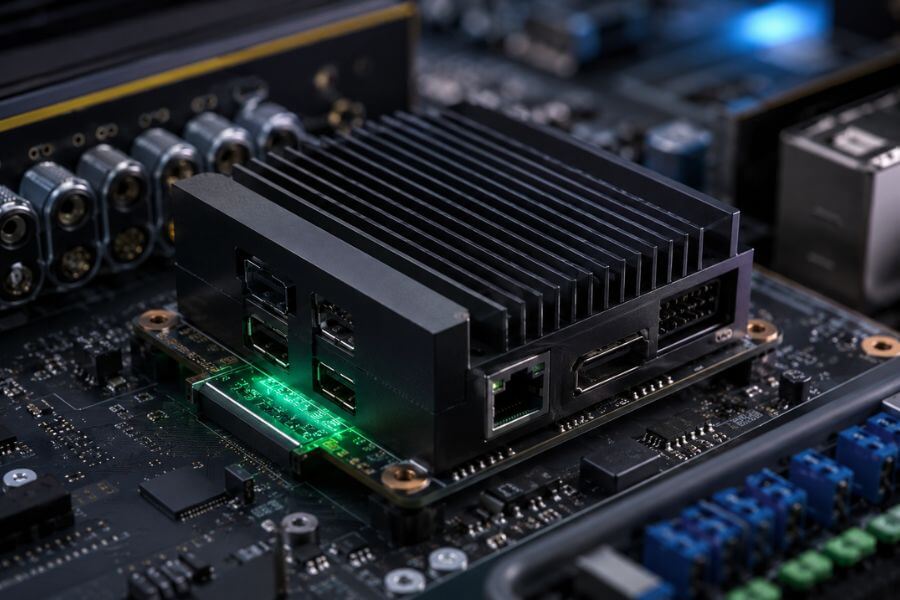
NVIDIA Jetson has become one of the most popular hardware and software platforms for running AI models at the edge. While technically a hardware-focused ecosystem, its software stack and developer tools make it a complete edge AI platform.
Jetson devices excel at real-time inference tasks such as:
- Object detection
- Image classification
- Video analytics
- Robotics navigation
- Autonomous systems
The platform benefits from NVIDIA’s GPU acceleration technology, which enables impressive performance even with compact devices.
What makes Jetson impressive:
- Outstanding AI inference speed
- Strong computer vision capabilities
- Wide developer community
- Excellent AI framework support
- Scalable product lineup
For developers building AI-powered cameras, robots, or industrial inspection systems, Jetson remains one of the most capable options available.
4. Google Distributed Cloud Edge 🌐
Google Distributed Cloud Edge helps organizations bring Google’s infrastructure closer to where data is generated. It combines cloud-native technologies with edge computing capabilities.
The platform is designed to support low-latency applications while maintaining centralized visibility and control. Businesses can deploy AI workloads closer to users without sacrificing management efficiency.
Google’s expertise in machine learning and data analytics adds significant value to the platform.
Major strengths include:
- Advanced analytics capabilities
- Cloud-native architecture
- Strong machine learning support
- Flexible deployment options
- Enterprise scalability
Organizations seeking modern cloud-edge integration often find Google Distributed Cloud Edge highly attractive.
5. Red Hat OpenShift Edge 🛠️
Red Hat OpenShift Edge brings Kubernetes-powered management to distributed environments. It allows organizations to deploy containerized AI workloads consistently across data centers and edge locations.
The platform appeals to businesses that want flexibility without being locked into a single cloud provider.
OpenShift Edge supports:
- Hybrid cloud deployments
- Multi-cloud environments
- Containerized AI applications
- Centralized orchestration
- Automated updates
Its open architecture provides significant freedom for enterprises with complex infrastructure requirements.
For organizations seeking portability and flexibility, OpenShift Edge is a strong contender.
6. Edge Impulse 📱
Edge Impulse has become a favorite platform for TinyML and resource-constrained AI deployments. It focuses on helping developers build machine learning models for microcontrollers and small devices.
The platform simplifies tasks that traditionally required extensive expertise.
Developers can:
- Collect training data
- Build models
- Optimize performance
- Deploy directly to devices
- Monitor results
Its user-friendly interface lowers the barrier to entry for edge AI development.
Advantages include:
- Beginner-friendly tools
- Strong TinyML support
- Efficient model optimization
- Broad hardware compatibility
- Fast deployment workflows
For startups, researchers, and embedded developers, Edge Impulse provides exceptional value.
7. KubeEdge 🔗
KubeEdge extends Kubernetes capabilities to edge environments. As an open-source platform, it has gained considerable adoption among organizations seeking flexible and cost-effective edge computing solutions.
KubeEdge helps bridge cloud and edge infrastructure while maintaining a familiar Kubernetes management model.
Key features include:
- Open-source flexibility
- Lightweight architecture
- Offline operation support
- Device management capabilities
- Strong community support
Its cloud-native design makes it attractive for organizations already using Kubernetes.
For companies seeking customization and control, KubeEdge is one of the best open-source options available.
8. IBM Edge Application Manager 🏢
IBM Edge Application Manager focuses on managing large-scale deployments that may involve thousands or even millions of devices.
The platform automates software distribution, updates, and policy management across edge infrastructure.
This level of automation helps reduce operational complexity while improving consistency.
Notable strengths include:
- Massive scalability
- Automated workload distribution
- Strong security controls
- Centralized governance
- Enterprise-grade reliability
Large enterprises often choose IBM’s solution when managing highly distributed edge environments.
9. ZEDEDA 🌟
ZEDEDA is a specialized edge orchestration platform designed to simplify distributed edge infrastructure management.
Its platform provides centralized visibility across geographically dispersed deployments, making it easier to manage AI applications running in multiple locations.
Organizations value ZEDEDA for its operational simplicity.
Benefits include:
- Vendor-neutral architecture
- Strong security features
- Centralized management
- Simplified deployment processes
- Multi-site visibility
It is particularly useful for retail chains, industrial facilities, and organizations with many edge locations.
10. Canonical MicroCloud 🔧
Canonical MicroCloud is emerging as a powerful, lightweight edge platform for AI workloads. Built by the company behind Ubuntu, it provides an efficient way to deploy cloud-like capabilities in smaller environments.
MicroCloud focuses on simplicity, making it easier for teams to create scalable edge infrastructure without excessive complexity.
Its strengths include:
- Lightweight resource usage
- Easy deployment
- Strong Linux ecosystem support
- Cost-effective infrastructure
- Flexible scaling capabilities
Organizations looking for efficient edge environments often find MicroCloud a compelling solution.
Conclusion 🎯
Edge computing is becoming a critical part of modern AI deployment strategies. As smaller AI models become more capable, organizations increasingly want to run them closer to users, devices, and operational systems.
The best platform for you depends on your goals. AWS IoT Greengrass and Azure IoT Edge work well for organizations already invested in those ecosystems. NVIDIA Jetson excels in AI-powered hardware deployments. Open-source solutions like KubeEdge provide flexibility, while Edge Impulse makes TinyML development accessible to a wider audience.
By choosing the right edge computing platform, you can reduce latency, improve privacy, lower operational costs, and unlock new AI-powered experiences that would be difficult to achieve through cloud infrastructure alone.
Frequently Asked Questions ❓
Can small AI models run entirely offline?
Yes. Many edge computing platforms support fully offline AI inference. Once the model is deployed to the device, it can process data locally without requiring continuous internet access.
What hardware is commonly used for edge AI?
Popular hardware includes AI-enabled cameras, industrial gateways, microcontrollers, single-board computers, edge servers, and specialized AI accelerators such as GPUs and NPUs.
Is edge computing more secure than cloud computing?
Edge computing can improve privacy because sensitive data stays closer to its source. However, security still depends on proper device management, encryption, software updates, and access controls.
How often should edge AI models be updated?
The update frequency depends on the application. Some models may require monthly improvements, while others can run effectively for years with minimal changes.
Which industries benefit the most from edge AI?
Manufacturing, healthcare, logistics, retail, agriculture, transportation, smart cities, energy, and robotics are among the industries seeing the greatest benefits from edge AI deployments.