Table of Contents
The logistics industry is going through one of the biggest transformations in its history. Labor shortages, rising warehouse costs, growing e-commerce demand, and the need for around-the-clock operations are pushing companies to look beyond traditional automation.
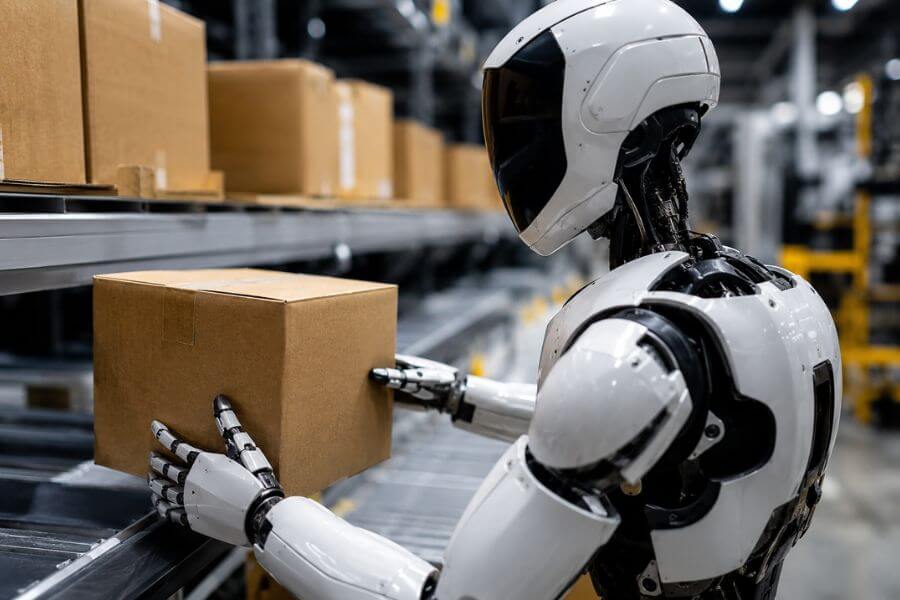
This is where humanoid robotics startups are making a major impact. Unlike conventional warehouse robots that follow fixed paths or perform a single task, humanoid robots are designed to work in environments built for humans. They can walk through warehouses, handle inventory, pick products, move packages, and even collaborate with human workers.
If these technologies continue advancing at their current pace, the future warehouse may look very different from what you see today. In this guide, you’ll discover the most disruptive humanoid robotics startups that are helping reshape logistics operations this year.
Quick Summary Table 📊
| Rank | Startup | Country | Primary Logistics Focus |
|---|---|---|---|
| 1 | Figure AI | United States | Warehouse automation and material handling |
| 2 | Agility Robotics | United States | Distribution center operations |
| 3 | Apptronik | United States | Warehouse labor assistance |
| 4 | Sanctuary AI | Canada | General-purpose warehouse work |
| 5 | 1X Technologies | Norway | Human-centered logistics support |
| 6 | Fourier Intelligence | Singapore | Industrial humanoid applications |
| 7 | UBTECH Robotics | China | Smart warehousing and fulfillment |
| 8 | EngineAI | China | Warehouse mobility solutions |
| 9 | Booster Robotics | China | Industrial logistics operations |
| 10 | RobotEra | China | Flexible warehouse task automation |
How We Ranked These Startups 🤖
We evaluated each company using several factors that matter most to logistics operators and industry leaders:
- Real-world logistics deployments
- Warehouse automation capabilities
- Technology innovation
- Commercial readiness
- Funding strength and growth potential
- Scalability across large distribution networks
- AI and autonomy capabilities
- Human-robot collaboration features
- Market influence and partnerships
- Potential to disrupt traditional logistics workflows
1. Figure AI ⭐
Figure AI has become one of the most talked-about humanoid robotics startups in the world. The company focuses on creating autonomous humanoid robots that can perform physically demanding tasks in industrial settings.
What makes Figure particularly interesting for logistics is its focus on warehouse environments. Its robots are designed to move products, transport materials, and perform repetitive handling tasks that traditionally require human labor.
For logistics companies facing labor shortages, Figure offers a vision of a workforce that can operate continuously without fatigue. The company’s rapid development pace and strong industry partnerships have helped it become a leader in the humanoid robotics space.
Key strengths include:
- Advanced AI decision-making
- Human-like mobility
- Warehouse-ready applications
- Strong investor backing
- Fast commercialization efforts
2. Agility Robotics 🚀
Agility Robotics is widely recognized for its humanoid robot called Digit. Unlike many experimental robots, Digit has been specifically designed for logistics and warehouse environments.
Digit can walk through facilities, carry containers, move inventory, and assist with repetitive warehouse workflows. The robot’s human-like form allows it to navigate spaces already designed for people.
This creates a significant advantage because companies do not need to completely redesign facilities to accommodate automation.
Why logistics leaders are paying attention:
- Proven warehouse use cases
- Human-friendly design
- Strong mobility capabilities
- Integration with existing facilities
- Focus on operational efficiency
3. Apptronik ⚙️
Apptronik is building humanoid robots aimed at supporting industrial operations, including logistics and fulfillment centers.
Its flagship humanoid platform has been developed with flexibility in mind. Rather than performing only one task, Apptronik’s robots are intended to adapt to different warehouse activities.
This flexibility can be especially valuable for logistics providers that experience changing demand patterns throughout the year.
Major advantages include:
- Adaptable task performance
- Human-centered robot design
- Industrial deployment focus
- Scalable architecture
- Strong engineering expertise
4. Sanctuary AI 🧠
Sanctuary AI is focused on creating general-purpose humanoid robots capable of handling a wide range of tasks that humans perform daily.
For logistics companies, this means a robot that could eventually assist with picking, packing, sorting, inventory management, and material movement.
The company’s approach centers on developing intelligence alongside physical capability. This combination could help warehouses automate increasingly complex workflows.
Notable strengths:
- General-purpose functionality
- Advanced AI systems
- Human-like manipulation skills
- Multi-task adaptability
- Long-term scalability potential
5. 1X Technologies 🤝
1X Technologies has attracted attention through its focus on safe and collaborative humanoid robots.
Rather than replacing workers entirely, the company emphasizes robots that can work alongside people in operational environments.
In logistics settings, this approach could help businesses improve productivity while maintaining a human workforce for tasks requiring judgment and flexibility.
Reasons for growing interest:
- Collaborative operation model
- Safety-focused design
- Flexible deployment options
- Strong AI integration
- Warehouse assistance potential
6. Fourier Intelligence 🔬
Fourier Intelligence has built a reputation through robotics innovation and is increasingly expanding into humanoid robotics.
Its technology combines advanced mobility, manipulation capabilities, and AI-powered control systems.
For logistics operators, these capabilities could support warehouse workflows that require precise handling and movement of goods.
Key highlights:
- Strong robotics expertise
- Advanced motion systems
- Human-like movement capabilities
- Expanding industrial applications
- Growing global presence
7. UBTECH Robotics 📦
UBTECH Robotics is one of the largest robotics companies actively developing humanoid systems for commercial applications.
The company has invested heavily in AI, robotics hardware, and intelligent automation technologies.
Its logistics-focused efforts target fulfillment centers and warehouse operations where repetitive labor remains a major challenge.
Standout qualities include:
- Large-scale robotics experience
- AI-powered automation
- Smart warehouse integration
- Commercial deployment expertise
- Strong manufacturing capabilities
8. EngineAI 🏭
EngineAI is emerging as an innovative player in humanoid robotics with a strong focus on mobility and industrial applications.
The company’s robots are designed to move efficiently through complex environments while carrying out practical tasks.
For logistics facilities that need adaptable automation solutions, this mobility-first approach can offer significant advantages.
Why it stands out:
- Advanced locomotion systems
- Industrial deployment focus
- Flexible operational capabilities
- Growing technology portfolio
- Strong innovation pipeline
9. Booster Robotics 📈
Booster Robotics is gaining attention for its efforts to create practical humanoid robots that can be deployed across industrial environments.
The company focuses on balancing performance, affordability, and operational reliability.
In logistics, these factors are critical because warehouse operators often prioritize return on investment over experimental technology.
Important strengths:
- Cost-conscious development
- Industrial applications
- Practical automation focus
- Reliability-oriented design
- Expansion potential
10. RobotEra 🌎
RobotEra is developing humanoid robots capable of handling diverse operational tasks across multiple industries, including logistics.
Its robots are designed to interact with existing environments and perform tasks that would otherwise require human labor.
As warehouse automation continues to evolve, RobotEra’s adaptable approach positions it as a startup worth watching.
Reasons it made the list:
- Flexible automation capabilities
- Human-like movement
- Growing industry presence
- Logistics application potential
- Continuous technology development
Conclusion 💡
Humanoid robotics is moving from science fiction to practical reality, especially in logistics. Warehouses and fulfillment centers face increasing pressure to process more orders, operate faster, and overcome labor shortages. Humanoid robots offer a compelling solution because they can work in facilities already built for people.
Companies like Figure AI, Agility Robotics, Apptronik, and Sanctuary AI are leading the charge, while emerging innovators across North America, Europe, and Asia continue pushing the technology forward.
If current progress continues, humanoid robots could become a common sight in warehouses over the next few years. For logistics providers, the biggest question is no longer whether humanoid robotics will play a role in operations, but how quickly the technology can scale to meet real-world demand.
Frequently Asked Questions ❓
Are humanoid robots better than traditional warehouse robots?
Not necessarily. Traditional warehouse robots excel at highly repetitive tasks in controlled environments. Humanoid robots offer greater flexibility because they can navigate spaces designed for humans and perform a wider variety of tasks.
How expensive are logistics humanoid robots today?
Costs vary significantly depending on the company and deployment model. Most current solutions remain expensive compared to traditional automation, but prices are expected to decrease as production scales.
Can humanoid robots completely replace warehouse workers?
In the near term, humanoid robots are more likely to assist workers rather than replace entire teams. Human employees still provide problem-solving, adaptability, and decision-making skills that remain difficult to automate.
What logistics tasks are easiest for humanoid robots to automate?
Material transport, inventory movement, package handling, sorting, pallet support, and repetitive warehouse workflows are among the most promising applications today.
When will humanoid robots become common in warehouses?
Many experts believe adoption will accelerate over the next five to ten years as hardware improves, AI becomes more capable, and deployment costs become more affordable for businesses of all sizes.