Table of Contents
Industrial robotics is entering a new era. For decades, robots followed fixed instructions and worked best in highly controlled environments. Today, physical AI is changing everything. Instead of simply repeating programmed tasks, modern robots can understand their surroundings, learn from experience, adapt to changes, and make decisions in real time.
As physical AI becomes more advanced, factories, warehouses, logistics centers, and manufacturing plants are becoming smarter and more efficient. These breakthroughs are helping businesses reduce costs, improve safety, increase productivity, and solve labor shortages.
If you want to understand where industrial robotics is heading, these are the most disruptive physical AI breakthroughs transforming the industry right now.
Quick Summary Table 📊
| Rank | Physical AI Breakthrough | Primary Impact |
|---|---|---|
| 1 | Vision-Language Robotics | Better understanding of tasks and environments |
| 2 | Autonomous Mobile Manipulation | Flexible movement and handling |
| 3 | Robot Foundation Models | General-purpose robotic intelligence |
| 4 | Reinforcement Learning at Scale | Faster robot skill development |
| 5 | Sim-to-Real Training | Reduced deployment costs |
| 6 | Tactile AI Sensing | Human-like touch capabilities |
| 7 | Digital Twin Intelligence | Real-time optimization |
| 8 | Multi-Robot Collaboration | Improved workflow coordination |
| 9 | Adaptive Grasping Systems | Handling diverse objects |
| 10 | Self-Learning Industrial Robots | Continuous performance improvement |
How We Ranked These Breakthroughs 🏆
We evaluated each technology using the following factors:
- Potential to transform industrial operations
- Real-world deployment readiness
- Impact on productivity and efficiency
- Ability to reduce labor challenges
- Scalability across industries
- Long-term economic value
- Improvement in safety and reliability
- Level of innovation compared to traditional robotics
- Adoption by major manufacturers
- Future growth potential
1. Vision-Language Robotics 👁️
One of the biggest breakthroughs in physical AI is the combination of computer vision and natural language understanding. Traditional robots require precise programming for every task. Vision-language robots can interpret both visual information and human instructions.
Instead of manually coding every movement, you can simply tell the robot what needs to be done. The robot analyzes its environment, identifies objects, and determines the best way to complete the task.
For example, a warehouse worker might instruct a robot to “pick up the damaged box and place it in the inspection area.” The robot can identify the box, understand the request, and perform the action without extensive programming.
This breakthrough dramatically reduces setup time and makes automation more accessible to businesses of all sizes.
2. Autonomous Mobile Manipulation 🚚
Traditional industrial robots are often fixed in place. Autonomous mobile manipulation combines mobility with robotic arms, creating machines that can move freely while performing complex tasks.
These robots navigate warehouses, factories, and distribution centers while carrying, sorting, assembling, or transporting materials.
The result is greater flexibility. Instead of bringing products to stationary robots, robots can travel directly to where work needs to be done.
This technology is especially valuable in logistics operations where layouts frequently change, and efficiency depends on rapid movement across large facilities.
As navigation systems become more intelligent, autonomous mobile manipulators are becoming a cornerstone of next-generation industrial automation.
3. Robot Foundation Models 🧠
Foundation models revolutionized artificial intelligence, and now they are transforming robotics as well.
Robot foundation models are trained using massive amounts of data gathered from simulations, sensors, cameras, and real-world operations. Rather than learning a single task, these models develop broad knowledge that can be applied to many situations.
This allows robots to transfer knowledge from one task to another. A robot trained to organize parts may also learn packaging, sorting, inspection, and assembly tasks with minimal additional training.
For industrial organizations, this means faster deployment, lower development costs, and greater operational flexibility.
Many experts believe foundation models will become the foundation of truly general-purpose industrial robots.
4. Reinforcement Learning at Scale 🎯
Reinforcement learning allows robots to learn through trial and error. Instead of being programmed step by step, robots discover the most effective actions by interacting with their environment.
Recent advances in computing power and AI algorithms have enabled reinforcement learning at an unprecedented scale.
Thousands or even millions of simulated training scenarios can be run before a robot enters the real world. During training, the robot continuously improves its performance by maximizing successful outcomes.
This approach helps robots master difficult tasks such as assembly, sorting irregular objects, precision handling, and autonomous decision-making.
The result is faster learning and more capable industrial systems.
5. Sim-to-Real Training 🌐
One major challenge in robotics has always been the cost of training robots in physical environments. Sim-to-real training solves this problem.
Engineers create highly realistic digital simulations where robots can practice millions of tasks safely and efficiently. Once the robot develops the necessary skills, the knowledge is transferred into the physical machine.
This breakthrough dramatically reduces development time and operational costs.
Companies can test workflows, train robots, and optimize performance without disrupting production lines or risking equipment damage.
As simulations become increasingly realistic, the gap between virtual training and real-world execution continues to shrink.
6. Tactile AI Sensing ✋
Humans rely heavily on touch when handling objects. Until recently, robots lacked this capability.
Tactile AI sensing gives robots a sense of touch through advanced sensors that detect pressure, texture, force, vibration, and movement.
This breakthrough allows robots to handle delicate products with greater precision.
In manufacturing environments, robots can assemble fragile components, inspect product quality, and safely interact with sensitive materials.
Tactile sensing also improves safety because robots can react immediately when unexpected contact occurs.
As these systems continue improving, robotic dexterity is beginning to approach human capabilities.
7. Digital Twin Intelligence 🔄
Digital twins are virtual replicas of physical machines, facilities, and production systems.
When combined with physical AI, digital twins become powerful decision-making tools. Real-time data from robots and equipment continuously updates the virtual model.
This enables businesses to monitor performance, predict failures, optimize workflows, and test changes before implementing them in production.
Digital twin intelligence helps manufacturers identify bottlenecks, improve resource utilization, and reduce downtime.
Instead of reacting to problems after they occur, companies can proactively prevent disruptions and maximize operational efficiency.
8. Multi-Robot Collaboration 🤝
Industrial environments increasingly rely on groups of robots working together.
Modern physical AI systems enable robots to communicate, coordinate, and share information in real time.
Multiple robots can divide workloads, adjust responsibilities dynamically, and collaborate on complex projects.
For example, one robot may transport materials, another may perform assembly, and a third may conduct inspections. Together, they create highly efficient workflows.
This coordinated approach improves throughput while reducing operational bottlenecks.
As collaboration algorithms continue to advance, robot teams are becoming more effective than isolated robotic systems.
9. Adaptive Grasping Systems 📦
Industrial facilities handle products of different shapes, sizes, materials, and weights.
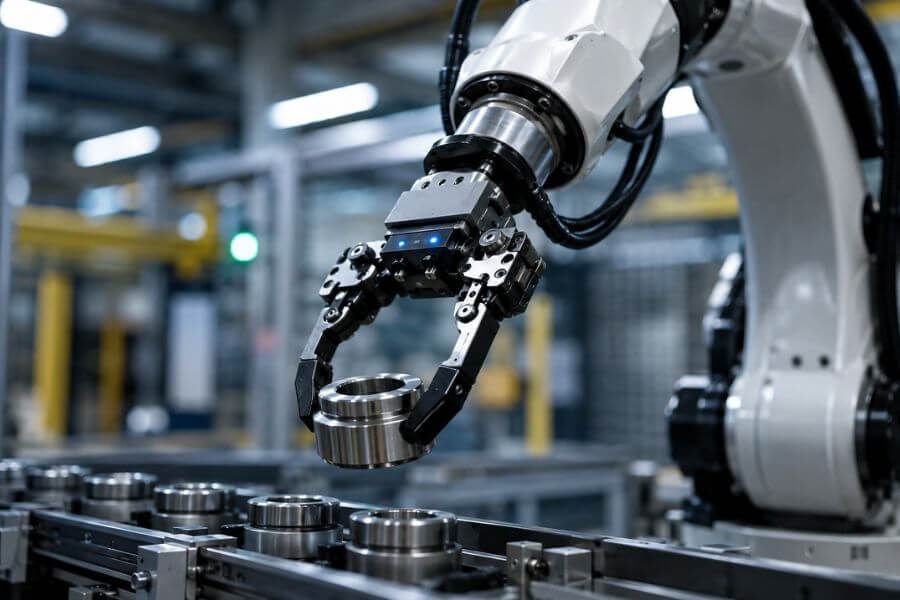
Traditional robotic grippers often struggle when objects vary significantly. Adaptive grasping systems solve this limitation through AI-powered perception and control.
These systems automatically determine the best way to grip an object based on its characteristics.
Whether handling electronics, automotive parts, food products, pharmaceuticals, or consumer goods, adaptive grasping enables robots to maintain accuracy and efficiency.
This breakthrough is particularly important in e-commerce fulfillment and warehouse operations where inventory constantly changes.
Greater flexibility means fewer custom tools and lower automation costs.
10. Self-Learning Industrial Robots 🚀
Perhaps the most exciting breakthrough is the emergence of self-learning industrial robots.
Instead of relying entirely on engineers for updates, these systems continuously learn from operational experience.
Every task completed provides additional data that can improve future performance. Over time, robots become more efficient, accurate, and adaptable.
Self-learning capabilities allow robots to adjust to environmental changes, identify new optimization opportunities, and handle unfamiliar situations more effectively.
For businesses, this creates long-term value because robotic systems improve rather than becoming outdated.
As AI continues advancing, self-learning robots could become one of the most transformative technologies in industrial history.
Conclusion 🔥
Physical AI is fundamentally changing industrial robotics. Robots are no longer limited to repetitive, pre-programmed actions. They are becoming intelligent systems capable of understanding environments, learning new skills, adapting to change, and collaborating with humans and other machines.
Breakthroughs such as vision-language robotics, robot foundation models, tactile sensing, reinforcement learning, and self-learning systems are pushing automation far beyond traditional boundaries.
If you operate in manufacturing, logistics, warehousing, or industrial production, these innovations will likely shape the future of your business. Organizations that embrace physical AI early may gain significant advantages in productivity, efficiency, safety, and competitiveness.
The next decade of industrial robotics will not simply be about automation. It will be about intelligent machines that continuously learn, improve, and work alongside people in ways that were once considered impossible.
Frequently Asked Questions ❓
What is physical AI in industrial robotics?
Physical AI refers to artificial intelligence systems that interact directly with the physical world through robots, sensors, cameras, and machines. It enables robots to perceive, learn, make decisions, and perform tasks autonomously.
Which industries benefit most from physical AI robotics?
Manufacturing, automotive production, warehousing, logistics, electronics, pharmaceuticals, food processing, and aerospace industries are among the largest beneficiaries of physical AI technologies.
Are physical AI robots replacing human workers?
In most cases, physical AI robots are designed to assist workers rather than completely replace them. They often handle repetitive, dangerous, or physically demanding tasks while humans focus on supervision, problem-solving, and strategic activities.
How expensive is implementing physical AI robotics?
Costs vary widely depending on the complexity of the system. While advanced robotic solutions can require significant investment, improvements in AI software, cloud computing, and simulation technologies are making adoption more affordable over time.
What is the biggest challenge facing physical AI today?
One of the biggest challenges is ensuring reliable performance in unpredictable real-world environments. Robots must be able to adapt to changing conditions while maintaining safety, accuracy, and operational efficiency.