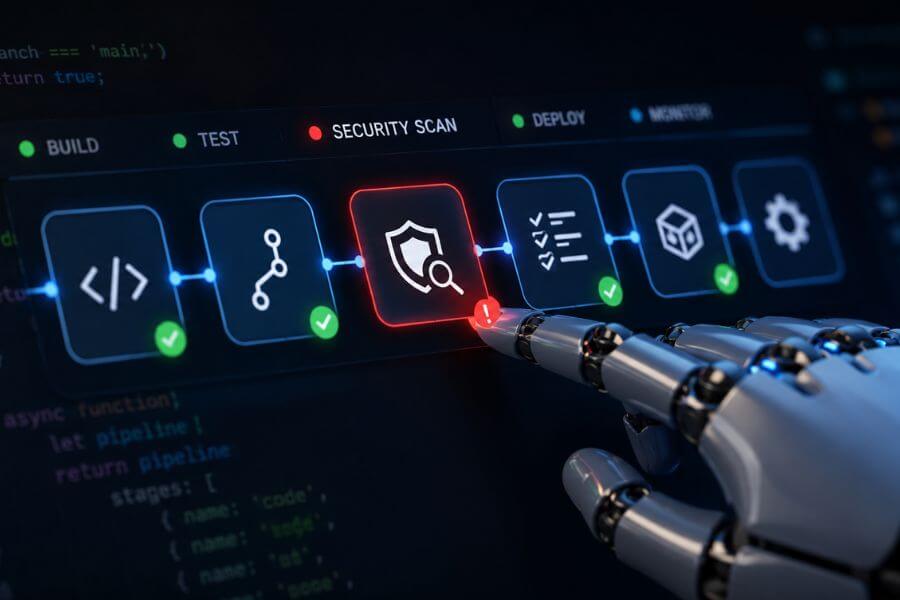
DevSecOps has become the standard approach for building and deploying software securely and efficiently. As development teams release code faster than ever, manually managing security checks, compliance reviews, infrastructure monitoring, and incident response is becoming increasingly difficult.
This is where AI agents are making a major impact. Modern AI agents can monitor code repositories, analyze security vulnerabilities, automate compliance tasks, generate remediation recommendations, investigate incidents, and even orchestrate complex workflows across your entire software delivery pipeline.
In 2026, the best AI agents do much more than simple automation. They act as intelligent teammates that help developers, security engineers, and operations teams reduce risks while improving productivity.
In this guide, you’ll discover the 10 most reliable AI agents for automating DevSecOps pipelines in 2026 and learn how each solution can help strengthen your software development lifecycle.
Quick Summary Table 📊
| Rank | AI Agent | Best For | Key Strength |
|---|---|---|---|
| 1 | GitHub Copilot Agent Mode | Secure software development | End-to-end coding assistance |
| 2 | Microsoft Security Copilot | Security operations | Threat investigation and response |
| 3 | Google Cloud Gemini Agents | Cloud-native DevSecOps | Infrastructure automation |
| 4 | Amazon Q Developer | AWS environments | Security-aware cloud workflows |
| 5 | GitLab Duo Agentic AI | Complete DevSecOps platforms | Integrated pipeline automation |
| 6 | Dynatrace Davis AI | Observability and monitoring | Root cause analysis |
| 7 | CrowdStrike Charlotte AI | Cybersecurity operations | Threat hunting automation |
| 8 | Palo Alto Networks Cortex AI Agents | Security orchestration | Automated incident response |
| 9 | Datadog Bits AI | Monitoring and troubleshooting | Operational intelligence |
| 10 | Harness AI Engineering Assistant | CI/CD optimization | Delivery pipeline automation |
How We Ranked These AI Agents 🏆
We evaluated each AI agent using several factors that matter most for DevSecOps teams:
- Reliability in production environments
- Security and compliance capabilities
- Integration with existing development tools
- Automation depth across the software lifecycle
- Incident response effectiveness
- Infrastructure management support
- Scalability for enterprise workloads
- Ease of deployment and adoption
- Accuracy of recommendations
- Overall value for DevSecOps teams
1. GitHub Copilot Agent Mode 💻
GitHub Copilot has evolved far beyond code completion. Its Agent Mode is becoming one of the most capable AI assistants for DevSecOps environments.
The platform can understand development tasks, generate code, review pull requests, identify security weaknesses, and suggest fixes before vulnerabilities reach production. It acts almost like a virtual team member that continuously assists developers throughout the software lifecycle.
One of its biggest advantages is its tight integration with development workflows. Teams can automate code reviews, security scanning recommendations, documentation generation, and remediation tasks without leaving their development environment.
Why it’s reliable:
- Deep integration with developer workflows
- Strong vulnerability detection support
- Excellent code quality recommendations
- Large ecosystem and widespread adoption
2. Microsoft Security Copilot 🛡️
Microsoft Security Copilot is designed specifically for cybersecurity and security operations.
The platform uses large-scale threat intelligence combined with AI-driven analysis to help security teams identify threats, investigate incidents, and respond more efficiently. It can analyze enormous volumes of logs and security events within seconds.
For DevSecOps teams, this means faster vulnerability investigations and reduced time spent manually analyzing alerts.
Key advantages include:
- Automated threat investigations
- Natural language security queries
- Security incident summarization
- Integration with Microsoft security products
Organizations with large cloud environments often find significant productivity gains when using Security Copilot.
3. Google Cloud Gemini Agents ☁️
Google Cloud has expanded Gemini into a collection of intelligent agents capable of supporting DevSecOps operations.
These agents assist with infrastructure management, cloud security reviews, application deployment validation, and compliance monitoring.
The system excels in environments that rely heavily on cloud-native architectures and Kubernetes deployments.
Key strengths include:
- Infrastructure-as-code assistance
- Cloud security recommendations
- Kubernetes troubleshooting
- Multi-service workflow automation
If your organization operates primarily in cloud environments, Gemini Agents can significantly reduce operational overhead.
4. Amazon Q Developer ⚡
Amazon Q Developer has become one of the strongest AI-powered assistants for AWS-centric organizations.
The platform helps developers write code, diagnose infrastructure problems, review security configurations, and automate deployment workflows.
Its knowledge of AWS services allows it to provide highly specific recommendations that general-purpose AI assistants may miss.
Benefits include:
- AWS security best practices
- Infrastructure troubleshooting
- Automated configuration guidance
- Cloud deployment optimization
Organizations heavily invested in AWS often gain substantial efficiency improvements through Amazon Q.
5. GitLab Duo Agentic AI 🔧
GitLab has long promoted a unified DevSecOps platform, and GitLab Duo extends this vision through intelligent AI agents.
The platform can automate multiple stages of the software development lifecycle, including planning, coding, testing, security scanning, and deployment management.
Because everything exists within a single platform, teams gain visibility across the entire pipeline.
Major advantages:
- Native DevSecOps integration
- Automated security analysis
- Continuous compliance support
- Unified workflow management
For organizations seeking platform consolidation, GitLab Duo offers significant value.
6. Dynatrace Davis AI 📈
Dynatrace Davis AI focuses on observability, monitoring, and operational intelligence.
Unlike many AI agents that concentrate primarily on coding tasks, Davis AI helps operations teams understand system behavior, detect anomalies, and identify root causes automatically.
This capability becomes especially valuable in large-scale environments where thousands of services generate massive amounts of telemetry data.
Key benefits:
- Automatic root cause detection
- Infrastructure anomaly analysis
- Performance monitoring automation
- Reduced alert fatigue
Its reliability in complex production environments makes it a favorite among enterprise operations teams.
7. CrowdStrike Charlotte AI 🔍
CrowdStrike Charlotte AI brings agentic capabilities directly into cybersecurity operations.
The platform assists analysts by automating investigations, summarizing incidents, identifying attack patterns, and accelerating remediation efforts.
For DevSecOps teams, Charlotte AI helps bridge the gap between software development and security operations.
Why teams choose it:
- Advanced threat hunting
- Automated investigation workflows
- Security alert prioritization
- Faster incident response
Organizations facing sophisticated cyber threats benefit greatly from its automation capabilities.
8. Palo Alto Networks Cortex AI Agents 🔐
Palo Alto Networks has expanded Cortex into an intelligent security operations platform powered by AI agents.
These agents automate repetitive security tasks while helping teams respond to incidents more effectively.
One of the most valuable features is its ability to coordinate actions across multiple security tools and environments.
Highlights include:
- Security orchestration
- Automated response playbooks
- Threat detection automation
- Cross-platform visibility
This makes Cortex particularly attractive for enterprises with large and complex security infrastructures.
9. Datadog Bits AI 📡
Datadog Bits AI focuses on operational intelligence and observability.
The platform continuously analyzes logs, metrics, traces, and infrastructure data to identify issues before they become serious incidents.
Its conversational interface allows engineers to ask questions about system health and receive actionable recommendations.
Advantages include:
- Faster troubleshooting
- Intelligent incident summaries
- Performance optimization insights
- Infrastructure visibility
For teams managing distributed applications, Bits AI can dramatically improve operational efficiency.
10. Harness AI Engineering Assistant 🎯
Harness has become a popular choice for CI/CD automation, and its AI Engineering Assistant further strengthens its platform.
The assistant helps optimize build pipelines, identify deployment risks, automate troubleshooting, and improve software delivery performance.
It is particularly useful for organizations focused on release engineering and deployment automation.
Key benefits:
- Pipeline optimization
- Deployment risk analysis
- Automated troubleshooting
- Improved delivery reliability
Teams seeking faster and safer releases often find Harness to be a valuable addition to their DevSecOps strategy.
Conclusion 🌟
AI agents are rapidly transforming DevSecOps pipelines in 2026. Instead of relying on disconnected tools and manual reviews, you can now deploy intelligent agents that continuously monitor, analyze, and optimize your software delivery process.
GitHub Copilot Agent Mode remains one of the strongest choices for development-focused teams. Microsoft Security Copilot and CrowdStrike Charlotte AI excel in security operations. Google Cloud Gemini Agents and Amazon Q Developer provide exceptional cloud-native capabilities. Meanwhile, platforms like GitLab Duo, Dynatrace Davis AI, Datadog Bits AI, Cortex AI Agents, and Harness AI Engineering Assistant deliver specialized automation across critical DevSecOps functions.
The best solution depends on your existing technology stack, security requirements, and operational goals. However, organizations that successfully integrate AI agents into their DevSecOps workflows will likely achieve faster releases, stronger security, reduced operational costs, and greater reliability in the years ahead.
Frequently Asked Questions ❓
Can AI agents completely replace DevSecOps engineers?
No. AI agents are designed to assist engineers rather than replace them. Human expertise is still necessary for architecture decisions, risk management, compliance oversight, and handling complex incidents.
What is the biggest benefit of AI agents in DevSecOps?
The biggest benefit is automation. AI agents can reduce repetitive work, accelerate incident investigations, improve security monitoring, and help teams release software faster without sacrificing security.
Are AI-powered DevSecOps tools suitable for small businesses?
Yes. Many modern AI agents offer scalable pricing and deployment options. Small businesses can benefit from automation even if they have limited security or operations staff.
How do AI agents improve compliance management?
AI agents can automatically monitor configurations, identify policy violations, generate compliance reports, and provide recommendations to help organizations meet regulatory requirements.
What should you consider before adopting an AI agent?
You should evaluate integration capabilities, security controls, accuracy, scalability, cost, compliance support, and how well the AI agent fits into your existing DevSecOps workflows.